
Choosing the Right Manual Tile Cutter for Porcelain and Large-Format Tiles
Tile formats have become larger and porcelain has become a common choice across residential and commercial projects. Choosing the right manual tile cutter starts with the material, tile dimensions and the type of cuts the installation demands.
A tile cutter should be chosen around the tile — not just the tool.
For professional installers, cutting capacity is only one part of the decision. Tile material, dimensions, accuracy, repeatability and the way the material needs to be handled all influence which cutting system makes sense.
Choose a manual tile cutter with sufficient capacity for the tile dimensions you regularly work with and make sure it is designed for the material being cut. For larger formats, also consider whether the job has moved beyond conventional manual cutting into a specialist rail-cutting and handling application.
This distinction becomes increasingly important as tile sizes increase. A cutter that works perfectly for everyday formats may simply not provide the working capacity needed for a much larger porcelain tile.
Ceramic and porcelain place different demands on cutting.
The first question is what material will actually be cut. Ceramic and porcelain tiles can differ substantially in density and cutting behaviour, so the cutter needs to be appropriate for the intended application.
For installers regularly working with porcelain, a professional cutter designed for both ceramic and porcelain applications provides a more appropriate starting point than choosing purely on price or overall cutter length.
Consistency also matters. On a professional installation, the objective is not simply to complete one successful cut. The cutting system needs to support accurate, repeatable work throughout the project.
Match cutting capacity to the formats you actually install.
A manual tile cutter needs enough working capacity for the dimensions of the tiles being installed. This sounds obvious, but it becomes an important purchasing decision when an installer regularly moves between conventional and larger tile formats.
Professional everyday capacity
A practical option where the tile formats being installed fall comfortably within the cutter's working capacity.
Additional capacity
Useful where larger formats are regularly encountered and additional cutter length is required.
The correct choice therefore depends on the actual tile dimensions used across your projects. More capacity can provide flexibility, but the objective is to select the tool that suits the work rather than simply choosing the largest cutter available.
Look beyond maximum cutting length.
Capacity gets much of the attention when comparing manual tile cutters, but the supporting design of the cutter is equally important.
A stable base, smooth rail movement and useful measuring guides all contribute to a more controlled cutting process. For repeated work, measuring and alignment features can also reduce the time spent setting up successive cuts.
This is especially relevant for professional installers who need the same tool to perform consistently throughout an installation rather than for a single occasional job.
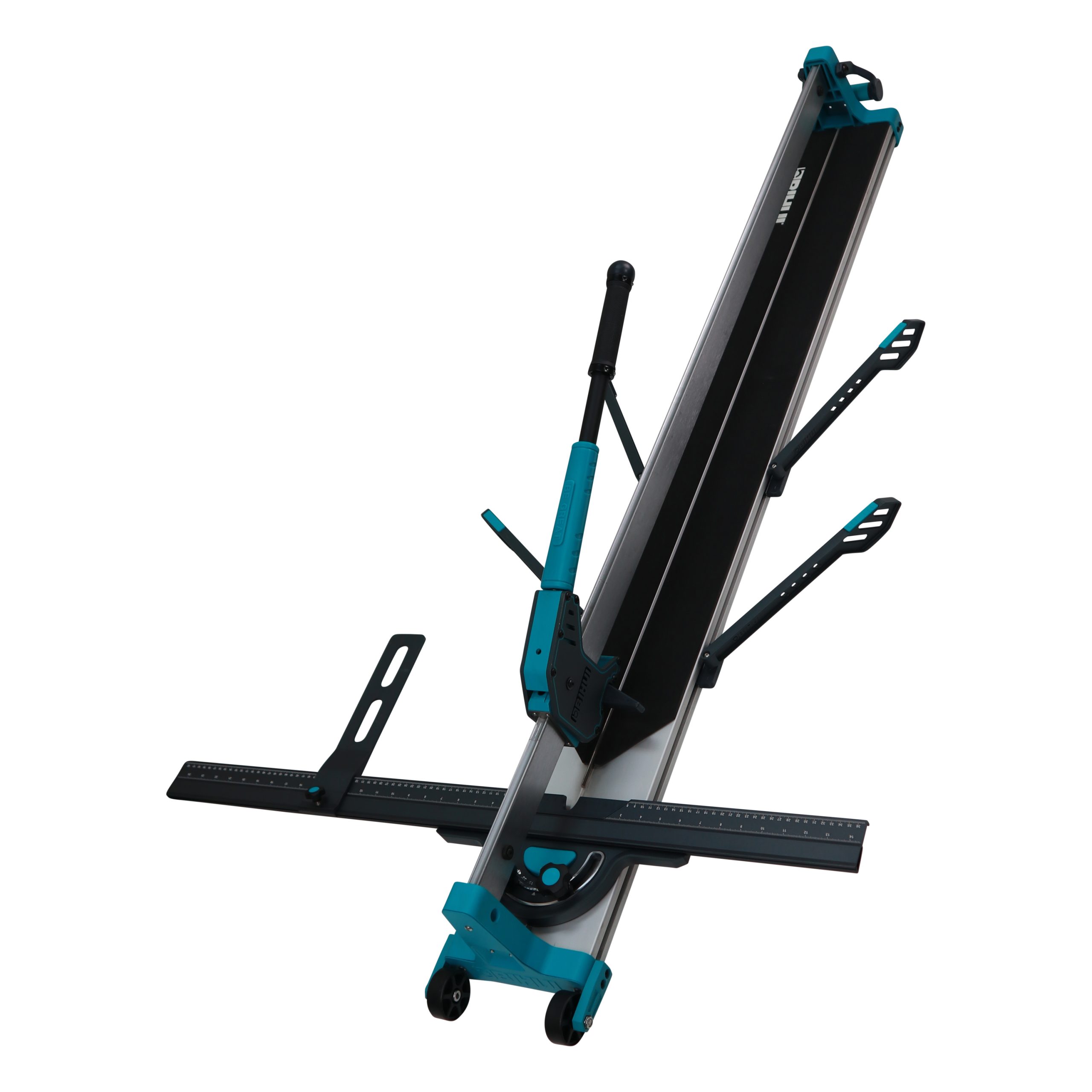
A professional manual cutting option.
The BIHUI Deluxe Tile Cutter is designed for ceramic and porcelain tile applications.
The range uses a double-layer aluminium base and solid single rail for smooth cutting, together with an adjustable measuring guide and side ruler. Laser guidance assists with cutting alignment.
Kirk offers the Deluxe Tile Cutter in 1200mm and 1600mm variants, allowing the cutter size to be matched more closely to the formats being installed.
View 1200mm CutterWhen does a conventional manual cutter stop being the whole solution?
As tile and slab dimensions increase, the challenge is no longer limited to making the cut. Handling, supporting, positioning and moving the material become part of the installation process.
This is where specialist large-format systems become relevant. Rail cutting equipment and dedicated handling systems can form part of a broader large-format workflow where conventional manual cutting alone is no longer the most appropriate approach.
BIHUI's wider professional tiling range includes large-format handling and rail-cutting solutions alongside its conventional manual tile cutters.
Explore the BIHUI professional tiling range and large-format solutions at Kirk.
Four questions to ask before choosing.
- What material are you cutting? Make sure the cutter is suitable for the ceramic, porcelain or other material being installed.
- What tile dimensions do you regularly encounter? Choose sufficient working capacity for your normal projects rather than considering cutter size in isolation.
- How important is repeatability? Professional work benefits from stable construction, smooth operation and useful measuring and alignment features.
- Are you moving into genuinely large-format work? If handling and supporting the material are becoming part of the challenge, consider whether a specialist large-format cutting and handling system is more appropriate.
Choosing around these questions helps match the cutting system to the work it actually needs to perform.
Manual tile cutter questions.
Can a manual tile cutter cut porcelain tiles?
Professional manual tile cutters can be designed for porcelain as well as ceramic tile. Check the manufacturer's stated application and ensure the cutter is appropriate for the material and tile dimensions involved.
Should I choose a 1200mm or 1600mm tile cutter?
The appropriate size depends primarily on the tile dimensions you regularly install. A 1600mm-class cutter provides additional working capacity, while a 1200mm-class cutter may be more appropriate where the tile formats fall within that capacity.
What matters besides cutting length?
Consider material suitability, stability, rail movement, measuring and alignment features and how consistently the cutter can support the work required across an installation.
What about very large-format tiles?
Very large formats can introduce handling, support and positioning requirements in addition to cutting. Specialist rail-cutting and large-format handling systems may therefore become part of the overall installation solution.
Explore BIHUI at Kirk.
Discover BIHUI professional tile cutters, large-format solutions, levelling systems, diamond tooling and specialist tiling equipment available through Kirk.
Explore BIHUI